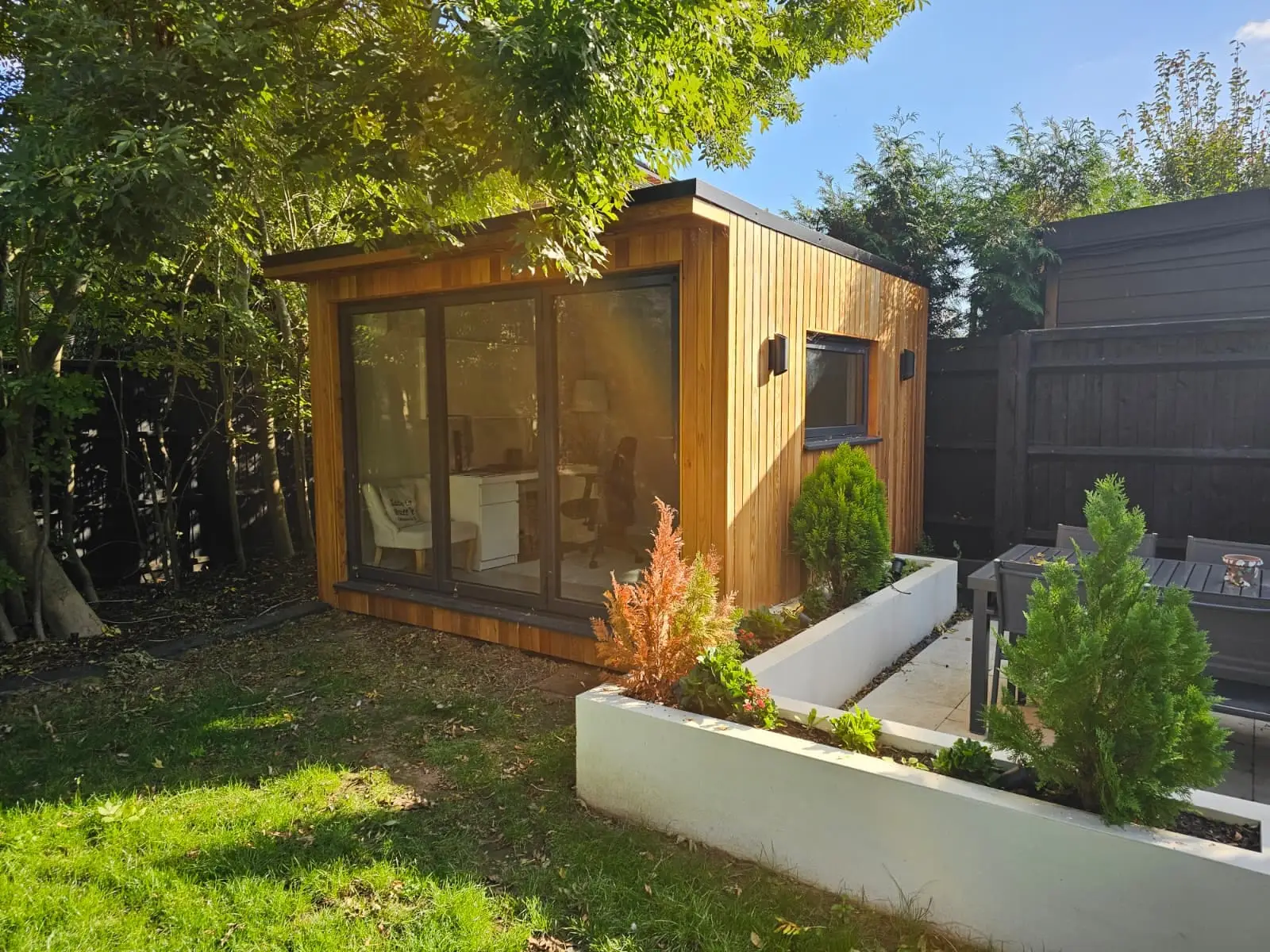
The Short Answer
Yes — our garden rooms are designed and built for year-round use. The key is construction method. SIPs (Structural Insulated Panels) deliver continuous insulation with no thermal bridging, achieving U-values around 0.18 W/m²K through the walls and roof. Pair that with an air conditioning heat pump or smart panel heater, and the room is as comfortable in January as it is in June.
Thin timber-frame garden rooms — the type you'll find from budget suppliers — are not suitable for year-round use. They're cold in winter, overheat in summer, and suffer condensation issues. That's why we use SIPs, and why our customers actually use their rooms every day.
What Makes the Difference
SIPs Construction
Structural Insulated Panels give continuous insulation through walls, floor and roof — no cold spots, no thermal bridging. U-value ~0.18 W/m²K, which exceeds modern building regulations.
Independent Heating
Electric panel heaters or air conditioning heat pumps provide fast, controllable heat. Heat pumps run at 300–400% efficiency, so they're significantly cheaper to run than direct electric heaters.
Proper Glazing
Double-glazed doors and windows are standard. We specify thermally broken aluminium frames that eliminate the cold spots common in cheaper aluminium or UPVC systems.
Insulated Floor
Cold floors make rooms feel cold even when the air temperature is comfortable. Our SIPs floor system is insulated as part of the panel — no additional floor insulation required.
Vapour Control
SIPs construction is inherently airtight and controls vapour movement, which is why condensation isn't an issue. Adequate ventilation via trickle vents is specified as standard.
Summer Cooling
An air conditioning unit handles both heating and cooling — critical for south-facing rooms in summer. A 9000 BTU unit manages a 5×3m room easily and can be added at any point.
Season by Season
Winter
December – February
Cold but Comfortable
A SIPs-built garden room handles Surrey winters without issue. Panel heaters or air source heat pumps bring the room to temperature quickly — typically 15–20 minutes for a 5×3m space from cold. The key is locking in heat once there: SIPs walls achieve U-values around 0.18 W/m²K, which is better than most new-build walls.
Spring
March – May
The Best Time to Be Out There
Spring is when most people fall in love with their garden room. Mild temperatures, plenty of natural light, and bifold doors open to the garden. No heating required on most days. If you have a gym or yoga studio, this is when it earns its keep.
Summer
June – August
Manage the Heat
Surrey summers can push temperatures into the high 20s and beyond. A well-oriented, well-insulated room stays cooler than a glass-heavy conservatory — but if you're working all day in direct sun, air conditioning transforms the experience. Our SIPs roof insulation significantly reduces radiant heat gain compared to timber frames.
Autumn
September – November
Settle In for the Long Haul
Autumn is the real test for a garden room. Temperatures drop, daylight shortens, and the question of whether it's actually usable gets answered. A quality SIPs build with good heating passes this test comfortably. Our customer Matt Grenyer waited 6 months before writing his review specifically to confirm: "The panel heater giving more than enough heat on the rare occasion it was needed."
SIPs vs Timber Frame — Thermal Performance Compared
| SIPs (The Green Rooms) | Typical Timber Frame | |
|---|---|---|
| Wall U-value | ~0.18 W/m²K | 0.3–0.5+ W/m²K |
| Thermal bridging | None — continuous insulation | Yes — at every stud |
| Condensation risk | Very low | Higher — cold spots at studs |
| Winter heat retention | Excellent | Poor to moderate |
| Summer overheating | Low | Higher — thin roofs absorb heat |
| Airtightness | High — panel joints taped and sealed | Variable — depends on build quality |
| Year-round rating | ✓ All seasons | ✗ Fair weather only |
Common Questions
What heating is best for a garden room?
For most rooms, we recommend either smart electric panel heaters (easy, cheap to install, controllable by app) or an air conditioning heat pump (efficient, heats and cools, increasingly popular). Heat pumps run at 300–400% efficiency, making them significantly cheaper to run over time. Underfloor heating is possible but adds cost and complicates the floor build-up.
Does condensation form on the windows?
Some condensation on external glazing is normal in cold weather — it means the glass is well insulated and the warm air from inside isn't reaching the outer pane. Internal condensation (on the room-facing side of the glass) should not occur with properly specified double glazing and adequate ventilation.
How much does it cost to heat a garden room in winter?
Running costs depend on insulation quality, room size, and how you heat it. A 5×3m SIPs room with a panel heater used 8 hours a day through winter typically adds £30–£70/month to electricity bills. An air conditioning heat pump running on the same pattern would cost £10–£30/month given its higher efficiency. Good insulation is the biggest factor in keeping running costs low.
Can I have air conditioning installed after the garden room is built?
Yes — air conditioning can be retrofitted. The unit mounts on an external wall, with a refrigerant pipe running through to an internal head unit. We'd ideally position the penetration point during the build to keep it clean and weatherproof, but it can be done later. Cost is typically £800–£1,500 installed.
Want to See Our Rooms in Person?
We have a showroom at our base in Lyne, Surrey — come and see the quality of the build, the cladding options, and ask us anything about year-round performance.