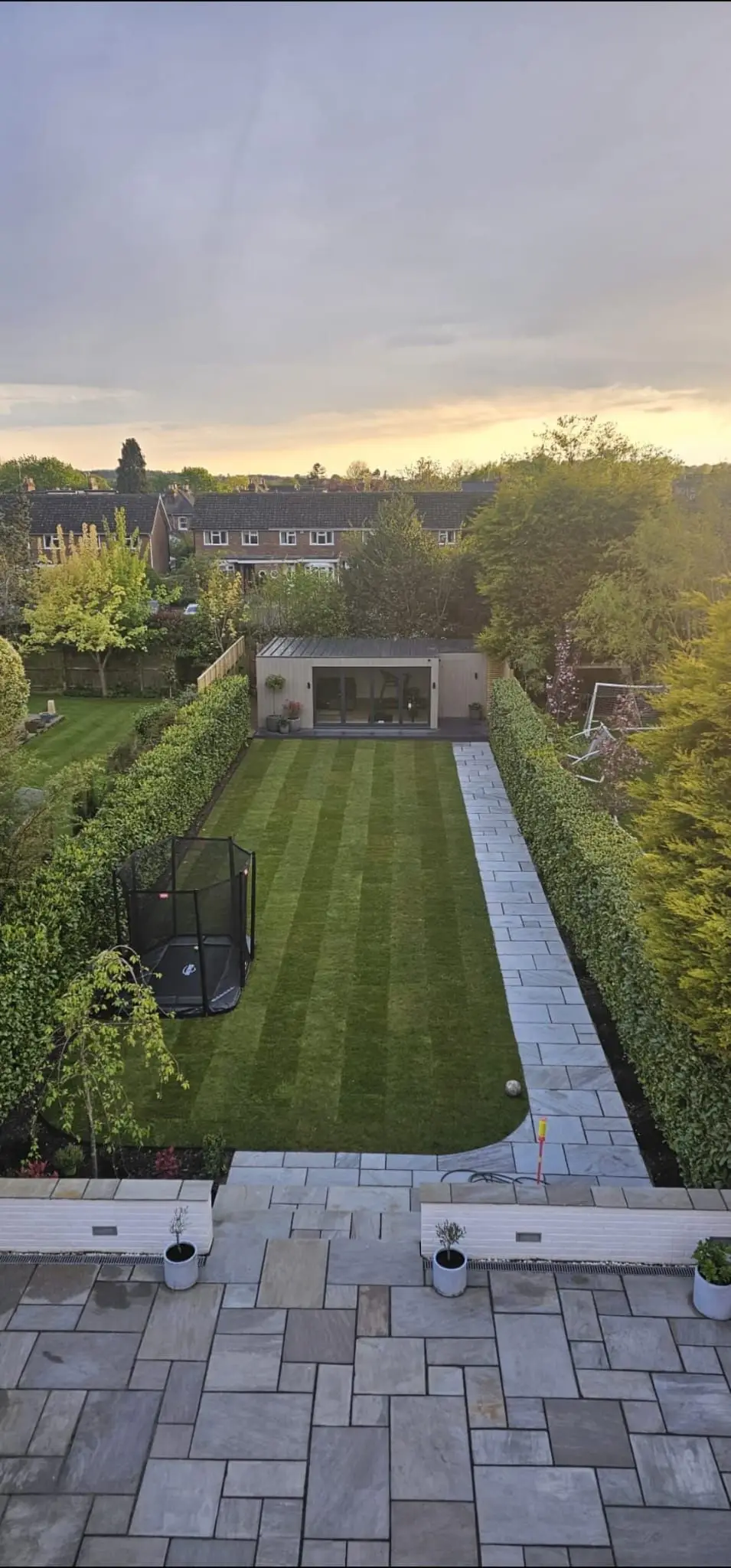
The Short Answer
A conservatory connects to your house and looks good in a brochure — but most are unusable for several months of the year without serious climate control. A garden room is a separate, properly insulated structure that stays comfortable year-round with standard heating. For anyone who wants to genuinely use the space every week, not just in May and September, a garden room is almost always the better choice.
The only advantage a conservatory holds is internal connection to the house. If that matters to you specifically, it's worth weighing. But for home offices, studios, gyms and everyday living space, the performance difference is significant.
Head-to-Head Comparison
| Garden Room | Conservatory | |
|---|---|---|
| Year-round comfort | Yes — SIPs insulation, stable temp | Often not — hot in summer, cold in winter |
| Roof construction | Insulated SIPs — same spec as walls | Glass or polycarbonate — poor thermal performance |
| Typical summer temperature | Controlled — same as any room | Can exceed 35°C with polycarbonate roof |
| Winter warmth | Retains heat with minimal input | Requires constant heating — high running costs |
| Cost (5×3m equivalent) | From £25,460 inc VAT | £20,000 – £60,000+ (quality glass / orangery) |
| Planning permission | Usually not required | Often PD if within limits — but attached to house |
| Building regulations | Electrical cert only | Exempt only if separated by external doors and under 30m² |
| Connected to main house | No — separate structure in garden | Yes — internal connection |
| Build time on site | 3–5 days | 4–8 weeks typically |
| Disruption to home | None — built entirely in garden | Some — wall opened, temporary access compromised |
| Insulation quality | SIPs — U-value 0.18 or better | Varies — often below modern standards |
| Property value impact | 5–15% for quality build | Varies — polycarbonate versions often viewed negatively |
| Lifespan | 30–50 years typical | Polycarbonate: 15–20 yrs; glass/orangery: 25–40 yrs |
The Temperature Problem Nobody Warns You About
The most common complaint about conservatories is one that rarely appears in the sales pitch: they become unusable for large parts of the year. A polycarbonate roof traps heat so effectively in summer that interior temperatures regularly exceed 35°C. In winter, the same roof radiates heat away so fast that the room is cold within an hour of turning the heating off.
Conservatory — the real-world experience
Garden Room — what SIPs construction delivers
What Does Each Actually Cost?
The entry-level conservatory price looks attractive until you realise what it delivers. A polycarbonate-roofed conservatory at £12,000–£18,000 will be hot, cold and uncomfortable for much of the year. A quality full-glass conservatory or orangery that genuinely competes on comfort is £30,000–£60,000 and still requires building regulation compliance.
Garden Room — what's included
From £25,460 inc VAT
5×3m Garden Room, fully installed
Conservatory — what to factor in
£10,000 – £60,000+
Depending on specification and roof type
When to Choose Each
Choose a Garden Room if…
Consider a Conservatory if…
Common Questions
Can a conservatory be used as a home office all year?
In practice, most conservatories are difficult to use as offices for much of the year. Screen glare from overhead glass, overheating in summer (often 30–35°C with polycarbonate roofs), and drafts in winter make sustained focus difficult. A dedicated garden office is designed around daily use: controlled glazing, proper insulation, and climate control as standard.
Does a conservatory add value to a house?
It depends heavily on quality. A well-built full-glass conservatory or orangery can add value — buyers see it as extra space. A basic polycarbonate conservatory, particularly one that's visibly old or underperforming, is often viewed negatively by buyers and surveyors because of energy performance and the cost of eventual replacement. A premium garden room from The Green Rooms typically adds 5–15% to property value and is increasingly sought after by buyers looking for home office space.
Is a garden room classed as an extension?
No. A garden room is an outbuilding — a separate, detached structure in the garden. This puts it under different planning rules (Permitted Development rights for outbuildings, not for extensions). It also means it doesn't need to comply with building regulations in most cases, unlike an attached extension or conservatory over 30m².
Can I replace my conservatory with a garden room?
You can absolutely remove an underperforming conservatory and invest in a garden room instead, though they're not direct replacements — one is attached to the house, the other is in the garden. Some clients who are frustrated with their conservatory choose to restore it and use it as a garden-facing room while adding a separate garden office or studio at the end of the garden. We're happy to talk through what would work best at a free site visit.
See What a Garden Room Would Cost
Get an instant guide price for your size and spec — or book a free site visit and we'll show you exactly what's possible in your garden.